Made Slowly
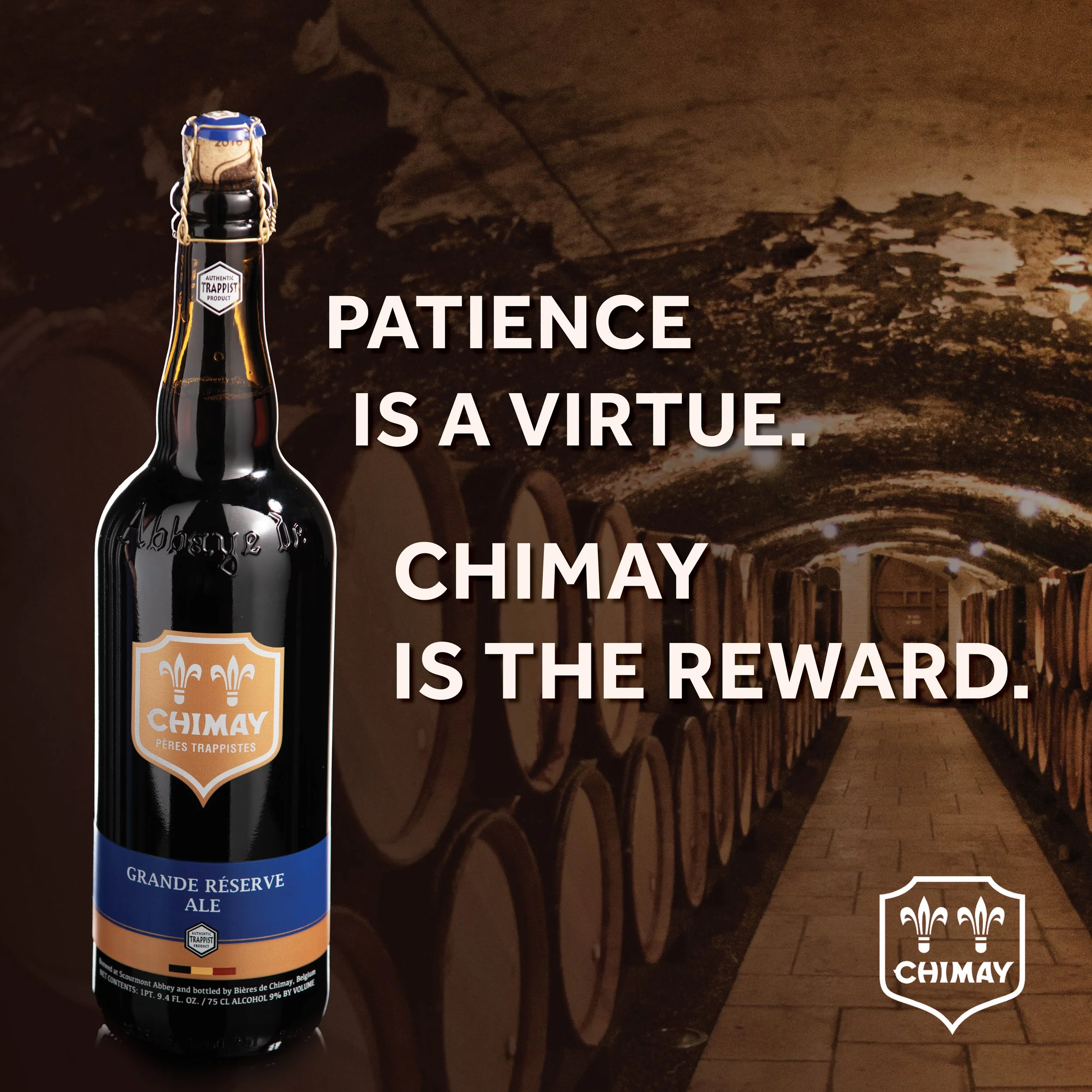
Chimay Grande Réserve — spec ad, 2026. Bottle: studio, ca. 2017. Cellar: Eric Cook via Unsplash.
The assignment was glass, which is harder than it sounds. Glass reflects everything — including the lights you're trying to use to photograph it, and the camera, and you. You can't just point a softbox at a bottle and expect it to look like anything. You have to light the space around it and let the glass take its shape from what it's reflecting, or backlight it through a scrim and flag off everything else in the room. And the dust — every speck shows up on dark glass, and the bottle seems to collect fingerprints just by looking at it, so you wipe it down, adjust the lights, and by the time you're ready to shoot there's more dust and another fingerprint. It's a problem of subtraction as much as addition. You spend most of your time figuring out what not to let the glass see.
I'd decided to focus on food photography that semester in my studio and commercial classes. It wasn't required; I had just taken an interest in that. So with the glass assignment, I wanted to tie in food too, or at least something food-adjacent.
To be honest, what I actually wanted to photograph was Chartreuse. I love anything to do with the Carthusians, and I love that particular green of the liqueur, which is made by monks at the Grande Chartreuse in the French Alps using a recipe of 130 different herbs and other botanicals that only two of them know at any given time. But Chartreuse is hard to find on a student budget, and it's not something you pick up on a whim at the corner store. So I went with what I could get: a bottle of Chimay, also made by monks, also glass with a label that had some weight to it.
I shot maybe fifty frames over an hour of this one bottle trying to nail the shot. I was thinking about the highlight wrapping the shoulder, and whether the label would blow out or hold detail. I wasn't thinking about the beer inside, or what it meant that I had reached — twice, now — for something made by a monastic community.
That was almost a decade ago.
The reward
When I pulled the photograph out recently, I built a spec ad around it. I composited the bottle into a stock image of a wine cellar — barrels receding into the dark — and matched the color temperature until the two images looked like one scene. The tagline came quickly: Patience is a virtue. Chimay is the reward.
What I love about the Trappists is the same thing I love about the food world in general — dedication to the craft, the refusal to rush, the willingness to keep doing the thing carefully for as long as it takes. The monks at Scourmont have been brewing since 1862. They make what they need to sustain the monastery, and then they stop. Scale isn't the point. The beer is the point, made slowly, by people who have been doing it for a long time.
There was a small satisfaction in seeing the old photograph find its home — the image I took of one bottle, on a wood stool I'd brought in from home, composited now with a cellar image by Eric Cook on Unsplash.
If this resonates, if you’re also making something slowly — drop me a line. I'd love to hear about it.